In the realm of materials science, the ability to predict and control structural transitions in elements under extreme conditions has far-reaching implications—particularly for sectors like aerospace, automotive, semiconductors, and energy.
At the heart of this work lies a fundamental question: What stabilises certain crystal phases of a material under pressure?
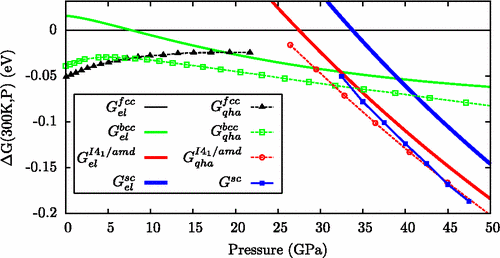
At the University of Liège, my collaborators and I addressed why standard models (DFT) fail to predict calcium’s simple cubic (sc) phase between 32 and 119 GPa. Using the SCAILD method, we revealed that anharmonic phonon effects, which conventional approximations ignore, are crucial to understanding phase stability under pressure.
Why It Matters
-
Smarter Materials Design: High-fidelity modelling supports tailored material discovery, cutting time and cost in sectors like aerospace, semiconductors, and energy.
-
Optimised Industrial Processing: Since certain phases stabilise only under specific temperatures, treatments like annealing or high-pressure forging can be fine-tuned for better performance and longevity.
-
Validation at Scale: While industrial systems typically operate at up to ~200 bar (20 MPa)—with advanced hydrogen tanks reaching 700 bar and calibration standards up to 1–1.6 GPa—our insights extend into the gigapascal regime, informing future design and safety standards.
-
Impact Potential: Our research is an example of how materials science can steer an industry at scale:
-
The global pressure vessels market size in 2024 stands at USD 56.8 billion
-
The high pressure pumps market size was over USD 4.35 billion in 2024 and is projected to reach USD 9.63 billion by 2037.
-
In the year 2025, the industry size of high-pressure pumps is assessed at USD 4.8 billion.
- etc …
-
-
Enabling Future Tech: As industrial sectors push toward hydrogen economy, CO₂ storage, and digital twins with realistic stress models, our approach offers foundational accuracy in extreme-pressure scenarios.
By advancing theoretical understanding of how quantum vibrations influence material phases, we’re not just solving academic puzzles—we’re enabling smarter, safer, and more efficient technologies for a high-pressure future.
The results have been published on Physical Review Letters. Here’s the PDF.